
Hand in a blue surgical glove holding on to a piece of lab equipment in a lab

Platforms and antibody performance

Gain insights from proficiency testing and a German ring study

Grey concentric circles on light background


CLDN18.2 Ring Study in Germany: Methods1

LABS:

  • 54 laboratories in Germany, Austria, and Switzerland participated in proficiency testing for immunohistochemical analysis of CLDN18.2 in gastric cancer samples using assays independently established in their institutions
    • One laboratory resigned from the program during the testing process


INDEPENDENT PROFICIENCY TEST (IPT):

  • 20 cases were stained and scored by 7 lead and panel institute pathologists using 3 different antibodies and 3 platforms, and a consensus score was determined for each case
  • Cases included varying levels of CLDN18.2 expression, including those with borderline expression


OPEN PROFICIENCY TEST (OPT):

A total of 10 consensus-scored and validated gastric cancer cases (6 CLDN18.2-positive and 4 CLDN18.2-negative) were selected from the IPT and sent to participating laboratories for the OPT
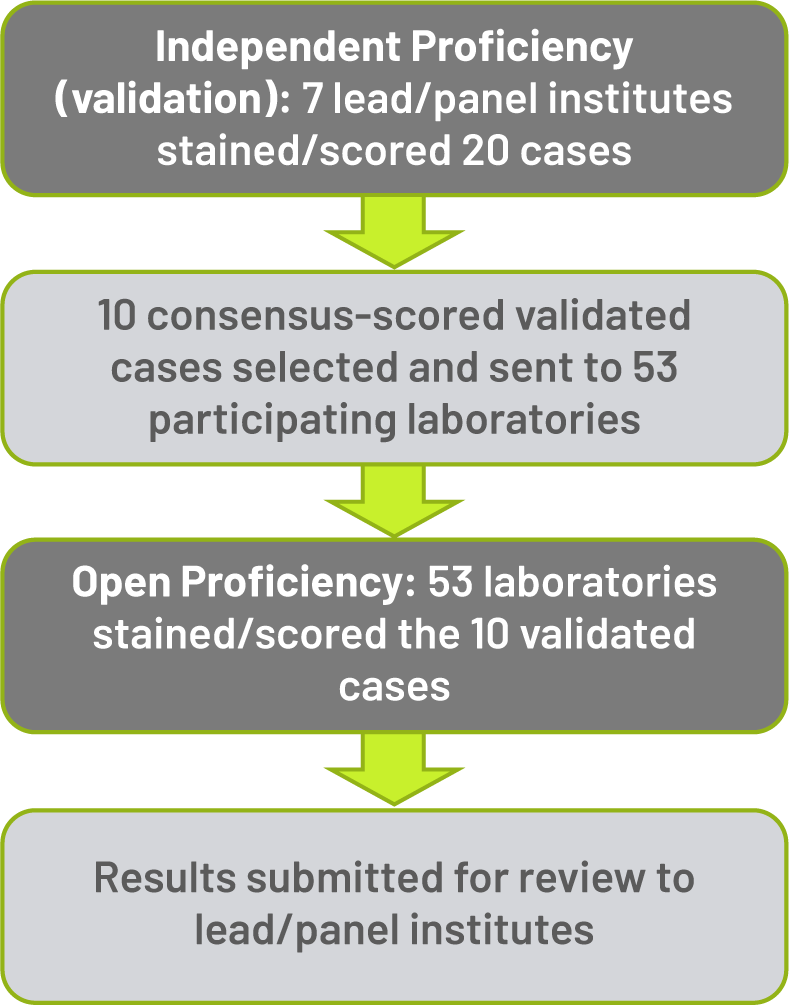

  • Participating institutes analyzed the cases using their established IHC protocols and submitted the CLDN18.2 status (positive/negative)
  • Scoring results were submitted for review by the lead/panel institutes’ pathologists and compared with the consensus reference values
LABS, INDEPENDENT PROFICIENCY TEST and OPEN PROFICIENCY TEST


Grey and green circles on dark background


CLDN18.2 Ring Study in Germany: Results

INDEPENDENT PROFICIENCY TEST: Of the 20 cases, 18 (90%) were evaluated consistently among the 7 institutions

OPEN PROFICIENCY TEST: The 10 selected cases were tested by 53 institutions. 42 institutions participated successfully (79.2%) by correctly evaluating CLDN18.2 status in ≥ 90% of cases

Main reasons for discordance were related to factors in staining protocols. Of the 53 institutes:

  • 13 (25%) had an isolated staining problem
  • 3 (6%) had an interpretation problem for individual cases
  • 2 (4%) submitted results with a low-quality staining combined with an occasionally incorrect interpretation

CLDN18.2 Ring Study in Germany: The choice of an appropriate antibody for CLDN18.2 detection was the key factor for overall performance quality1


The 43-14A clone (Ventana/Roche or Abcam) was associated with optimal staining results

Antibody (Manufacturer) Total Number of Laboratories Using Antibody Successful Categorization (Passing Rate, %) Problem Analysis
Staining Interpretation Staining and Interpretation
43-14A (Abcam) 2 2 (100) - - -
Polyclonal rabbit (Invitrogen/Thermo Fisher) 2 2 (100) - - -
VENTANA CLDN18 (43-14A) Assay (Roche Diagnostics) 28 27 (96) 1 2 -
PathPlus™ CLDN18 (LSBio) 3 2 (67) - 1 -
ZR451 (Zeta/Zytomed)a 9 5 (56) 7 - 1
EPR19202 (Abcam) 5 0 (0) 5 - -

a Participants who participated successfully with this clone submitted suboptimal stains.


  • Among the 10 LDT/IVD assays tested in the OPT, the CLDN18 (43-14A) clone (Ventana/Roche or Abcam) was the most commonly used, with no significant technical or interpretation issues noted overall
  • The 43-14A clone detects both CLDN18.1 and CLDN18.2 isoforms; however, this is not considered problematic for staining of primary gastric tumors because CLDN18.1 is predominantly expressed in the lung, whereas CLDN18.2 is specific to normal and malignant gastric mucosa
  • There were significant issues with staining quality associated with the CLDN18.2-specific ZR451 (Zeta/Zytomed) and EPR19202 (Abcam) clones 


ZR451

  • The poor performance of this clone was caused by its low specificity of staining
  • There was high-contrast membranous staining of the tumor cells, but also conspicuous strong cytoplasmic staining. Nonspecific weak staining of smooth muscle cells was observed


EPR19202

  • This clone demonstrated poor analytical performance due to lack of sensitivity, resulting in weak staining
  • This antibody showed predominantly cytoplasmic and weak membranous staining and thus exhibited both sensitivity and specificity problems

Global Ring Trial


In a global study assessing the reproducibility and comparability of three CLDN18 antibodies and IHC staining platforms across a cohort of 27 global laboratories2,*,†:

  • Analytical performance (accuracy, sensitivity, and specificity) of the VENTANA CLDN18 (43-14A) IVD Assay was up to 95% and reproducible across the 27 laboratories vs consensus reference results2
  • Analytical performance was equivalent to the VENTANA CLDN18 (43-14A) IVD Assay for the LSBio antibody when stained on the Dako or Leica platform2
  • Staining was reproducible for the LSBio antibody2

*Antibodies in the study comprised the VENTANA CLDN18 (43-14A) IVD Assay from Roche Tissue Diagnostics, the PathPlus™ CLDN18 Antibody from LSBio, and the Claudin-18 Antibody from Novus Biologicals. Platforms comprised BenchMark ULTRA, Dako Autostainer, and Leica Bond.2

Consensus reference scores from all antibodies for each sample were determined by central pathology review. CLDN18.2 positivity was defined with a threshold of ≥75% of tumour cells expressing membranous CLDN18 with moderate-to-strong (≥2+) staining intensity. Accordingly, participating pathologists were required to submit a binary positive/negative call as well as an estimation of the percent of cells stained. Laboratory-submitted IHC scores were compared to the reference consensus score and considered discordant if the positive/negative binary result differed. Statistical analysis was performed for comparison, and an acceptance criteria of 85% (≥0.85) was applied.2

CLDN18, claudin 18; CLDN18.1, claudin 18 isoform 1; CLDN18.2, claudin 18 isoform 2; IHC, immunohistochemistry; IPT, independent proficiency test; IVD, in vitro diagnostic; LDT, laboratory developed test; OPT, open proficiency test.


References: 1. Röcken C, Höhn AK, Neumann J, et al. Concordance of laboratory assays for claudin 18.2 in gastric cancer tissue samples: independent proficiency testing and a descriptive non-interventional study. Virchows Arch 2025 Jun 28. 2. Jasani B, Schildhaus HU, Taniere P, et al. Global ring study determining reproducibility and comparability of CLDN18 testing assays in gastric cancer. Poster presented at: ESMO Targeted Anticancer Therapies Congress; March 6-8, 2023; Paris, France.